Electron MicroscopeElectron MicroscopeElectron Microscope

Tham & Videgård was asked to design a new laboratory building for an electron microscope at the the Department of Physics, Chemistry and Biology at the Linköping University. The electron microscope is one of the most sophisticated in Europe and the building is intended to facilitate new materials research and new international research exchanges. The instrument is extremely sensitive to vibrations, sound and electromagnetic fields, which is why a new separate building was needed. It’s primarily the research department of Material Physics that will benefit from the new microscope, but also visiting foreign researchers.
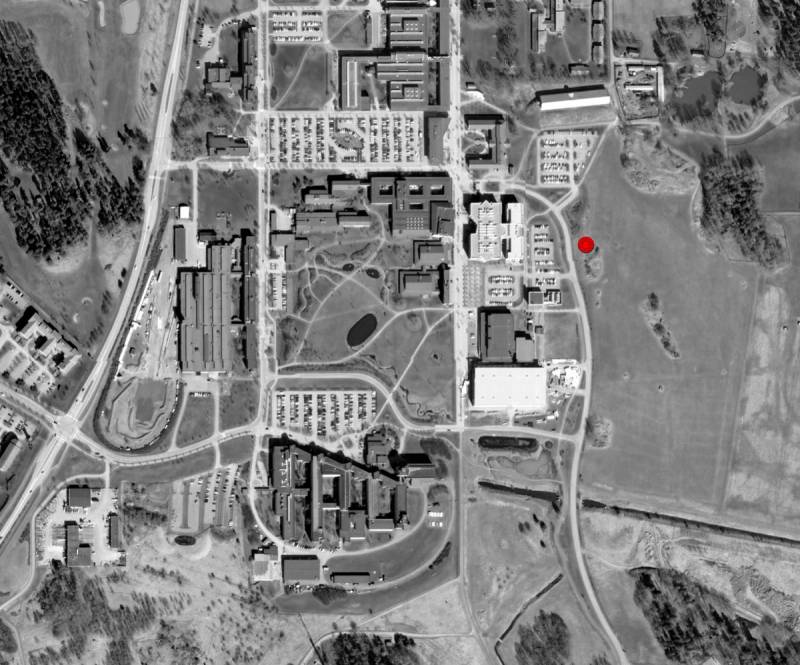
Because of the microscope’s sensitivity, it was important to select a site with as few disturbances as possible and to achieve the highest technological quality of construction. After trying several solutions entirely underground in the vicinity of existing research facilities, the conclusion was that a building above ground in a secluded place with the possibility of foundation directly on the mountain would be more appropriate.
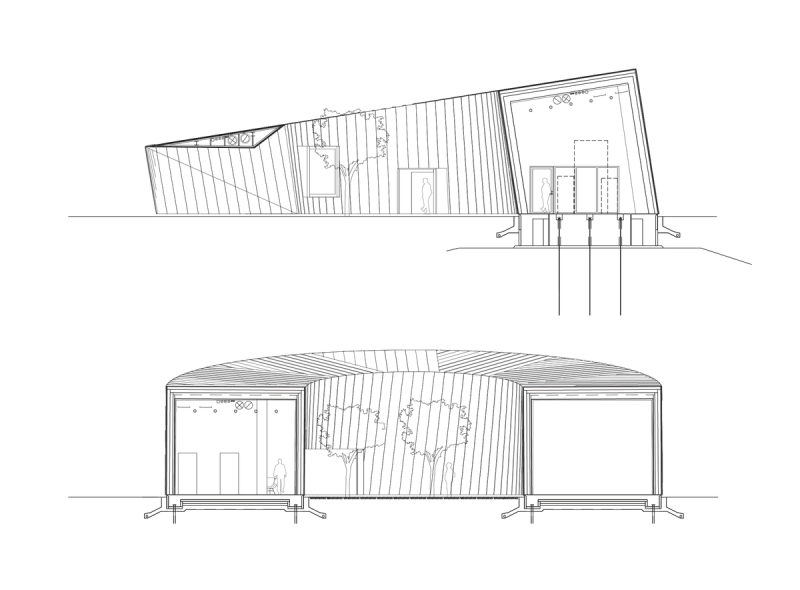
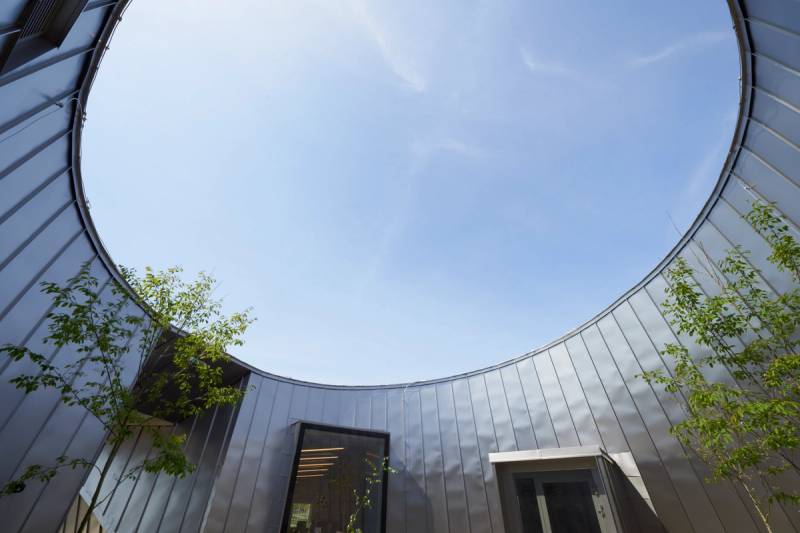
Tham & Videgård’s design is inspired by and reflective of the high-tech metallurgical research being conducted at the Linköping University. Freely positioned on a meadow at the edge of the campus, it has the shape of an inclined cylindrical ring covered with standing-seam titanium cladding that helps shield it from outside magnetic fields. Entrance and loading is by an open portico in the lowest point of the ring, and through the circular atrium courtyard. All room functions are organized around the courtyard, with the electron microscope located in the building's highest point.



The walls of the cylinder is canted at right angles to the slope of the roof, which has enabled a rational construction with the load bearing structure made of cast concrete (microscope room) and pre-fab steel. The precise geometry and reduced detailing lends the building a scaleless quality and allows it to appear as an abstract, shimmering ring in the open landscape.
After being put into use, it has proved that the instrument provides more accurate results here than in the microscope manufacturer's own laboratory. As a result the new Ångström house is now used as a reference project for future electron microscope buildings.